
By Simon Gedz, Local Realtor
Charles Rutenberg Realty · 30+ years of South Florida market expertise · Published 2026-09-14
I've been selling South Florida real estate since 1995, and I've watched three decades of New Yorkers make this exact move. The conversation always starts the same way: "If I sell my house in Garden City / Scarsdale / Great Neck, what can I actually buy down there?" The answer is usually better than they expect — with one honest caveat at the end.
The swap math: what your NY home buys here
Forget averages — here are the swaps I see closing every month, priced in real 2026 bands:
| What you sell in NY | NY price band | What it buys in South Florida | FL price band |
|---|---|---|---|
| Garden City or Rockville Centre colonial, Long Island | $900K – $1.2M | Fort Lauderdale single-family, Coral Ridge or Imperial Point Similar space — but you gain a pool, year-round outdoor living, and no state income tax. | $900K – $1.4M |
| Scarsdale or Rye colonial, Westchester | $1.4M – $2.2M | Waterfront with dock, Rio Vista fringe or Lighthouse Point The price of a landlocked Westchester home buys deep-water dockage here. | $1.5M – $2.5M |
| Manhattan 2-bedroom condo | $1.6M – $2.8M | Oceanfront condo, Galt Ocean Mile or Lauderdale Beach Direct sand frontage at half the carry — and HOA here often covers water, cable and amenities. | $700K – $2M |
| Great Neck or Manhasset estate, North Shore | $2.5M – $5M | Gated deep-water estate, Seven Isles or Boca Raton Same tier, but with a private dock and no January shoveling. | $2.5M – $6M |
The pattern is consistent: the closer your New York home is to Manhattan, the more the trade favors you. A Manhattan condo owner often arrives with enough equity to buy a direct oceanfront unit and bank the difference. A Long Island seller usually lands a bigger house with a pool for roughly the same money — then the tax savings start compounding.
Want to see exactly what your number buys today? Run it through the budget search — set your sale price as the max and browse live Fort Lauderdale and Boca Raton listings at that level.
The tax math that changes everything
This is the part most New Yorkers underestimate. Housing prices between the two metros can look similar on a listing site — the carrying cost is not:
| Tax | New York | Florida |
|---|---|---|
| State income tax | Up to 10.9% (plus NYC's own 3.9% for city residents) | None |
| Property tax, effective rate | Roughly 1.4%–2.5%+ depending on county and school district | Roughly 1.7%–2.1% in Broward before exemptions |
| Estate tax | Yes — kicks in just above $7.3M (2026) | None |
| Homestead protection | Limited | Up to $50K exemption plus 3% annual assessment cap |
| Tax on Social Security / retirement income | Partially | None |
A household earning $300,000 typically saves on the order of $20,000–$30,000 a year in state income tax alone. Add Florida's Homestead Exemption — up to $50,000 off assessed value plus a 3% annual cap on future increases — and the gap widens every year you own. Because Florida property tax millage varies by city and district, check the exact rate for any address you're considering on the property tax rates by city page before you write an offer.
What the money actually feels like
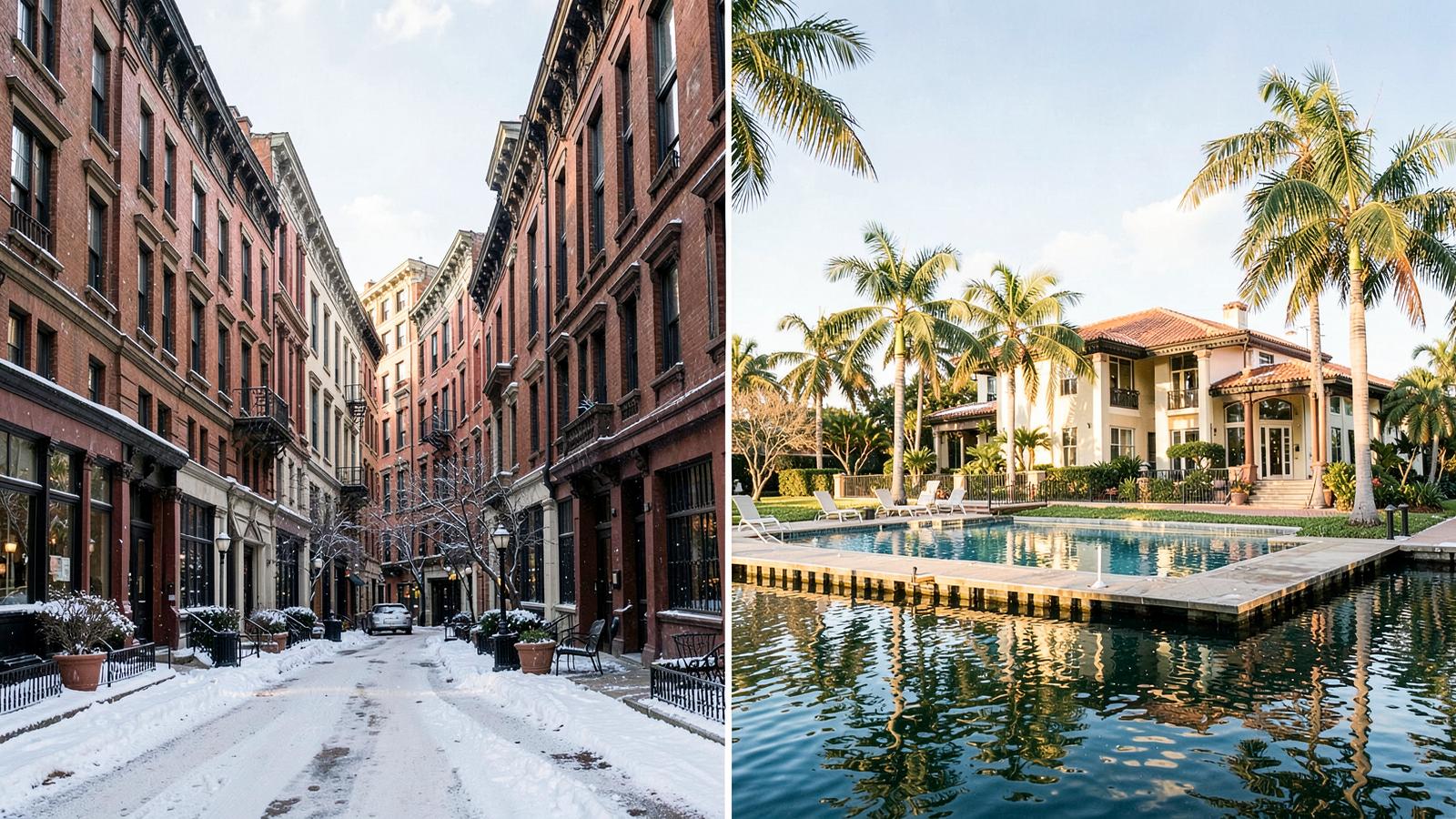
The lifestyle upgrade isn't abstract. A Westchester backyard becomes a pool you use eleven months a year. A driveway you shovel becomes a dock with your boat on it — Fort Lauderdale has more registered recreational boats than almost any city in the country. Heating bills disappear; your car isn't rusting under road salt; and January becomes your best month instead of your worst.
For a full monthly-cost breakdown — insurance, utilities, groceries, commuting — see the Fort Lauderdale cost of living guide.
The honest caveat: insurance
The one line item that surprises every New Yorker is homeowners insurance. Budget $4,000–$9,000 a year for a non-waterfront single-family home, and materially more east of the Intracoastal or in a flood zone. Roof age, impact windows and an elevation certificate move the premium far more than the purchase price does — so ask for the wind-mitigation report before you offer. Even counting insurance, most NY relocators with a working household net out ahead; the math just has to be honest.
Selling in New York? Let's run your real number.
Tell me what your NY home would sell for, and I'll show you exactly what it buys in Fort Lauderdale, Boca Raton and Palm Beach — with the taxes, insurance and monthly carry worked out before you fly down.
Frequently asked questions
How much home can I buy in South Florida if I sell my New York home?
As a rough 2026 guide: a $900K–$1.2M Long Island sale buys a comparable Fort Lauderdale single-family home; a $1.4M–$2.2M Westchester sale reaches waterfront homes with private docks; and a $1.6M–$2.8M Manhattan two-bedroom often swaps for a direct oceanfront condo at roughly half the carrying cost.
How much do New Yorkers save on taxes by moving to Florida?
Florida has no state income tax, no estate tax, and no tax on retirement income. A $300,000 household typically saves on the order of $20,000–$30,000 a year in state income tax alone, before counting the Homestead Exemption and assessment caps.
What costs surprise New Yorkers moving to South Florida?
Homeowners insurance — $4,000–$9,000 a year is the realistic band for a non-waterfront single-family home, higher east of the Intracoastal. Car insurance also runs high. Heating costs disappear; summer AC raises electric bills. Most relocators still net out well ahead.