
By Simon Gedz, Local Realtor
Charles Rutenberg Realty · 30+ years of South Florida market expertise · Published October 23, 2026
Originally published on my site.
You found the house. The backyard is beautiful, the sun is hitting the water just right, and there is a boat sitting at the dock that makes you imagine your next weekend out on the Atlantic. As of November 2026 on our site, there are 2,812 active homes in Fort Lauderdale with a median list price of $750,000, while the 1,182 waterfront homes show a median of $1,050,000. It is a significant investment, and the price point reflects that premium.
When you are buying waterfront real estate in Fort Lauderdale, due diligence must extend far beyond the house itself. I have been helping buyers navigate these specific waters since 1995, and I have seen too many people fall in love with the view only to discover the hidden costs of the infrastructure later. Here is how you perform your due diligence properly.
1. Evaluate the Home
Start with the property just as you would any other purchase. Do not let the sparkle of the water distract you from the foundation, the roof, or the HVAC. In South Florida, the salt air is a constant adversary. You need to inspect for corrosion on electrical panels, look for signs of moisture intrusion in the walls, and ensure the roof is not just visually intact but functionally sound. If you are looking at neighborhoods like Las Olas Isles or Coral Ridge, you are dealing with homes that have seen decades of salt exposure. Check everything.
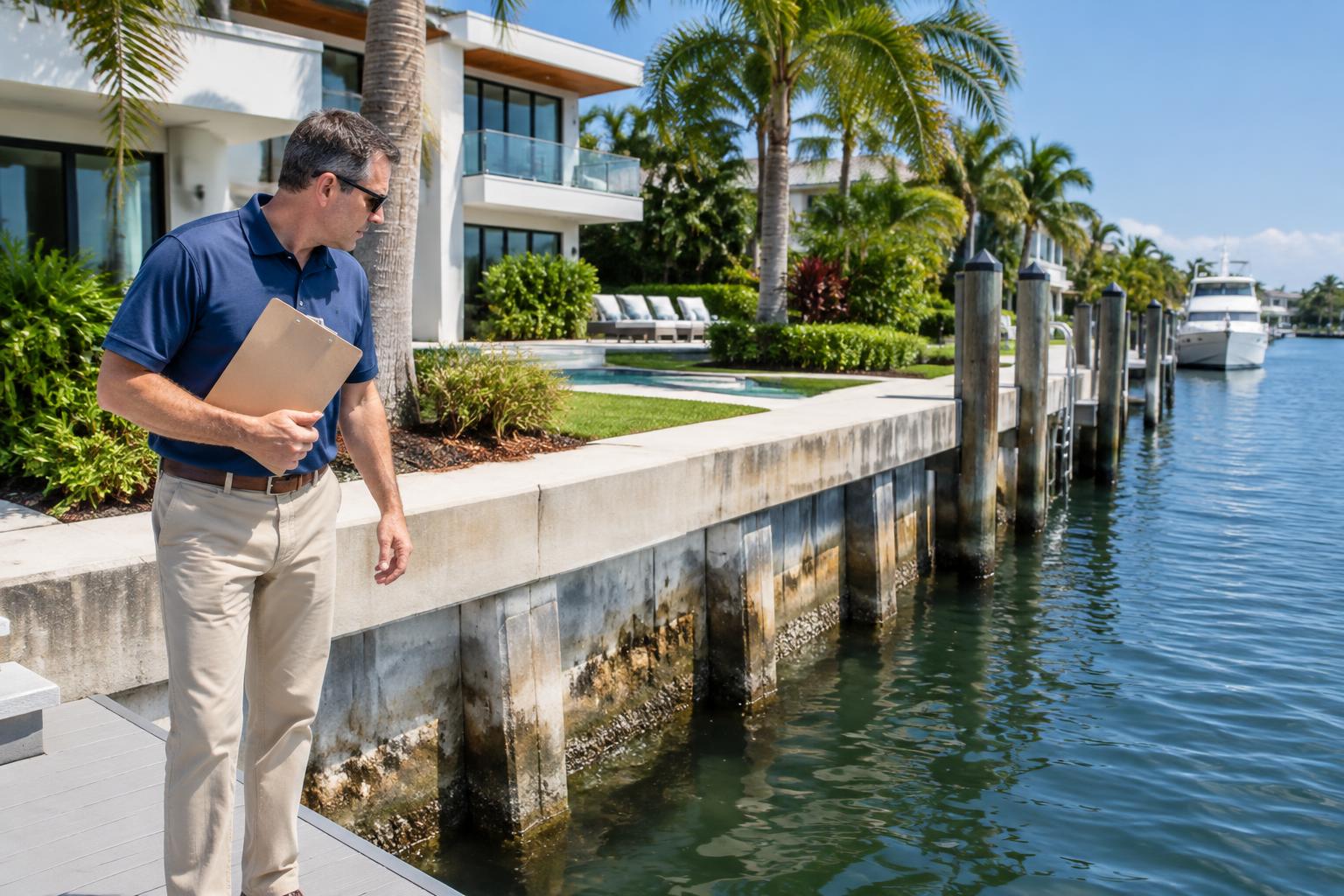
2. Evaluate the Seawall
The seawall is the most expensive single component of a waterfront home that most buyers completely ignore. If the seawall fails, the dirt behind it washes away, and your backyard goes with it. I always tell my clients: hire a marine contractor to inspect the wall. Look for cracks, leaning, or erosion behind the cap. A seawall replacement is a massive capital expenditure that you do not want to be surprised by six months after closing.
3. Evaluate the Dock
Does the existing dock actually work for your intended use? Do not assume that because the seller’s boat is there, yours will fit. You need to verify the length, the depth at low tide, and the electrical hookups. Is there a shore power pedestal? Is it wired for 30 or 50 amps? Use my Dock & Draft Match boat-fit search to get a clearer picture of whether the dock matches your vessel.
4. Investigate Permits and Improvements
If docks, boat lifts, or elaborate deck additions matter to your purchase, you must investigate the documentation. Everything built on the water in Fort Lauderdale requires permits from the city and often the Florida Department of Environmental Protection or the Army Corps of Engineers. If a previous owner built a dock without a permit, you could be the one hit with a code enforcement violation after you buy. I always verify that the square footage of the dock and the boat lift capacity matches the city records.
5. Understand the Waterway
Look beyond the backyard. Are you on a wide canal or a narrow finger island? The route from your property to the Intracoastal Waterway or the ocean is just as important as the house itself. Some canals are quiet, which is great for relaxing, but they can be shallow or difficult to navigate if you have a vessel with a deep draft or a large beam.
6. Investigate Bridges
If boating is a priority, you must identify every bridge between your house and the ocean. In areas like Rio Vista or Sunrise Key, you might find yourself navigating fixed bridges. If your boat has a flybridge or a tower, you need to know the clearance at high tide. You can find more detail on this in my fixed and drawbridge guide. Do not guess; get a tape measure and verify the height clearance for your specific vessel at mean high water.
7. Investigate Water Depth
Your boat's draft is non-negotiable. I have seen buyers purchase homes during high tide only to find their boat grounded in three feet of mud the following week. Always request an independent survey of the depth at your specific slip. If you are looking at different areas, compare them using my neighborhood comparison guide to understand which sections of the city generally offer deeper water.
8. Think About Maneuverability
Can your vessel comfortably approach and leave the property? If you are on a narrow canal and your neighbor has a large yacht anchored across the way, you might find it impossible to turn your boat around. Practice the approach before you finalize your offer. It is also wise to understand the rules regarding anchoring and mooring, which vary by municipality.
9. Understand Insurance
Insurance in South Florida is a complex beast. You are looking at a combination of homeowner’s insurance, flood insurance, and potentially windstorm coverage. Waterfront homes have specific risks, and carriers have become very strict about property age and roof condition. Do not wait until a week before closing to call your agent. Start the quoting process as soon as you have a contract in hand so you know exactly what your monthly carrying costs will look like. You can review my notes on the true cost of luxury ownership to prepare your budget.
10. Verify—Don't Assume
This is the central rule of waterfront due diligence. A listing description is the beginning of your research, not the end. If the seller says "ocean access," verify if that means "no bridges" or "three fixed bridges." If they say "new roof," verify the year it was permitted. You should also make sure you understand your property tax implications; if you are relocating from out of state, be sure to read my Florida homestead exemption guide to see how you can save on your tax bill once you establish residency.
If you are just starting your search, you can browse all available waterfront homes in Fort Lauderdale to see what is currently on the market. If you are looking for guidance on how to navigate the specific zoning or permitting requirements for a property you have already identified, take a look at my waterfront permits guide.
When you are ready to get serious, you want someone in your corner who knows the difference between a high-tide clearance issue and a simple tide adjustment. You can see how I have helped others in my client reviews and read about the process of selling or buying with my team. Buying in Fort Lauderdale is a lifestyle decision, but it is also a significant financial one. Treat it with the respect it deserves, verify your data, and do not be afraid to walk away if the dock or the seawall do not pass the test.
Next step: When you are ready to tour these properties and need a professional eye to evaluate the seawalls and bridge clearances in person, call me, Simon Gedz, at 954-562-1798. We can start by narrowing down your search in Fort Lauderdale to the neighborhoods that best suit your boating and lifestyle needs.