
By Simon Gedz, Local Realtor
Charles Rutenberg Realty · 30+ years of South Florida market expertise · Published October 9, 2026
"I need a dock."
That is usually where the conversation starts when a client calls me. It sounds simple, but in the South Florida market, it is rarely that straightforward. I have been helping clients navigate these canals and the Intracoastal since 1995, and I have seen many buyers fall in love with a beautiful seawall only to realize later that it cannot accommodate their actual vessel.
As of November 2026 on our site, we are looking at 2812 active homes in Fort Lauderdale, with a median list price of $750,000. When you drill down into the waterfront segment, we see 1182 waterfront properties with a median price of $1,050,000. That is a significant investment, and the difference between a "waterfront home" and a "boater’s home" is often measured in inches and depth.
What Boat Are You Docking?
Your needs depend entirely on the vessel, but it is not just about the length overall (LOA). You need to account for beam width, draft, and the swing radius required to get in and out of the slip.
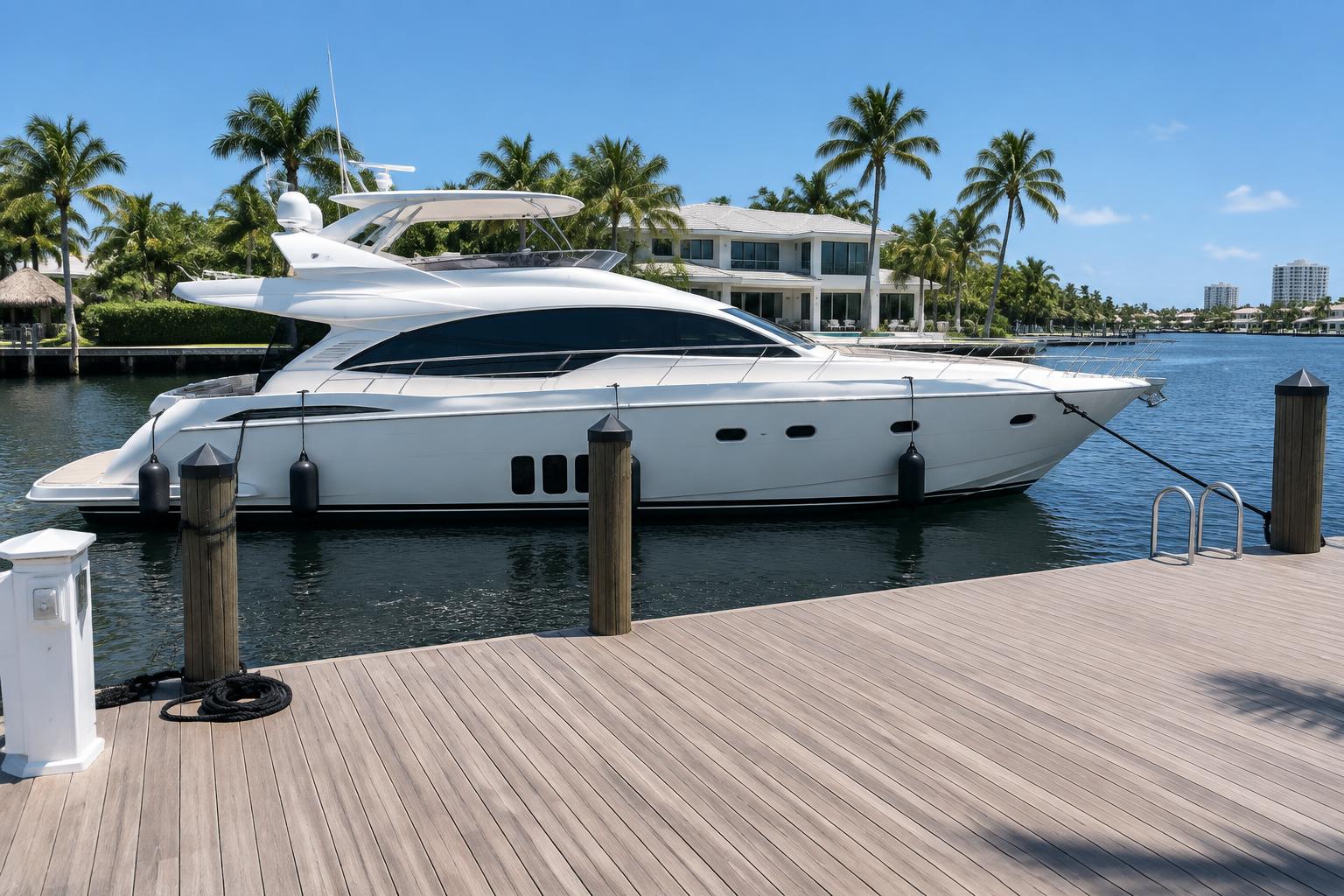
When you look at our list of waterfront homes for sale in Fort Lauderdale, do not simply look at the dock and decide it looks large enough. A dock might be 50 feet long, but if the canal is too narrow to maneuver a 45-foot yacht safely into that space, the dock is functionally useless for that specific boat. You have to consider the "turning basin" available in the canal. If you are looking at neighborhoods like Coral Ridge or Las Olas Isles, the width of the canal varies wildly. I always suggest that my clients bring their captain or a trusted marine surveyor to the property before we even submit an offer.
Think Beyond Today's Boat
If you are purchasing a luxury waterfront home, you likely expect to own it for a decade or more. I see many buyers move from a center console to a larger sportfish, or from a sportfish to a motoryacht.
Buying a property that barely accommodates today's needs could severely limit your tomorrow. You need to check the local municipal codes regarding dock extensions. In many parts of Fort Lauderdale, you cannot simply build a longer dock because you have infringed on the navigable channel. Before you buy, ask to see the survey and check the distance from the seawall to the center of the canal. You can browse our specialized search for homes by boat size to get a sense of which properties are designed for larger vessels versus day-cruisers.
Waterfront Frontage Isn't Necessarily Usable Dockage
This is the most common point of confusion for buyers moving to Florida from out of state. You might see a property listed with 100 feet of "waterfront frontage," but that does not mean you have 100 feet of dock space.
There are "setbacks" from your property lines that dictate how close your dock can be to your neighbor's space. Furthermore, the shape of your lot—whether it is on a corner, a point, or a standard mid-block lot—dictates how much of that frontage you can actually use. You might have a 100-foot lot, but once you account for the angle of the canal and the placement of your pilings, you might only have 60 feet of true, safe dockage. Always verify the actual usable dock configuration rather than assuming a listing's frontage measurement is the final word.
Measure Before You Commit
If a particular boat is essential to the purchase, verify that the property works for it. Do not guess. Do not rely on a photograph. And do not assume that because the previous owner had a boat there, your boat will fit.
Here is my practical checklist for the due diligence phase:
- Verify Water Depth at Mean Low Tide: Do not rely on a seller’s claim. Use a lead line or hire a surveyor. If you have a deep-draft vessel, you need to know exactly what the depth is at the lowest tide of the year, not just on a sunny day in July.
- Check Current and Tide Flow: Some canals in neighborhoods like Rio Vista have strong tidal currents. If you have a delicate vessel, maneuvering against a cross-current into a slip can be a nightmare.
- Review HOA and City Rules: Before you commit to a property, check the municipal regulations and any homeowner association rules regarding dock extensions, boat lifts, and even the type of boat you are allowed to keep at your dock.
- Inspect the Seawall: This is often overlooked. A beautiful dock is worthless if the seawall is failing. Have a professional marine engineer inspect the structural integrity of the concrete and the tie-backs.
- Assess Utility Access: Does the dock have dedicated power and water? If you are planning to keep a larger boat, you may need a 50-amp or 100-amp shore power service, which can be an expensive upgrade to install.
For those who are not sure which neighborhood fits their lifestyle, I recommend reviewing my Fort Lauderdale waterfront neighborhood comparison. It breaks down the pros and cons of different canal systems.
The Paperwork and Process
When you finally find the right property, the closing process for a waterfront home includes steps that a standard residential transaction does not. You will want to ensure the riparian rights are clear. You will also need to understand your potential for tax benefits; if this is your primary residence, make sure you look into the Florida homestead exemption guide to understand how it impacts your bottom line.
If you are coming from out of state, particularly if you are moving from New York to South Florida, keep in mind that our boating infrastructure is part of the local lifestyle, and the maintenance costs for waterfront property—from seawall upkeep to dock painting—should be part of your overall budget planning. You can get a general sense of the local market by browsing all homes for sale in Fort Lauderdale to see how prices shift as you move from the inland areas to the deep-water access points.
If you are serious about finding a home where you can step off your back porch and onto your deck, do not do it alone. I have been doing this for over 30 years, and I have helped hundreds of boaters find the right slip for their vessel. You can read some reviews from past clients to see how I approach the process of matching boaters with homes.
Whether you are looking for a shallow-draft bay boat setup or a deep-water dock for a yacht, we can use our Dock & Draft Match search tool to filter properties based on real-world dimensions. It saves you time and, more importantly, it prevents the disappointment of viewing a home that simply cannot accommodate your lifestyle.
If you are currently thinking about making a move, you can also explore the benefits of selling with me if you need to liquidate your current property before making your next waterfront purchase.
Next step: If you are ready to start looking at properties that actually match your boat’s specifications, call me, Simon Gedz, at 954-562-1798. Let’s make sure your next home is a perfect fit for you and your vessel.